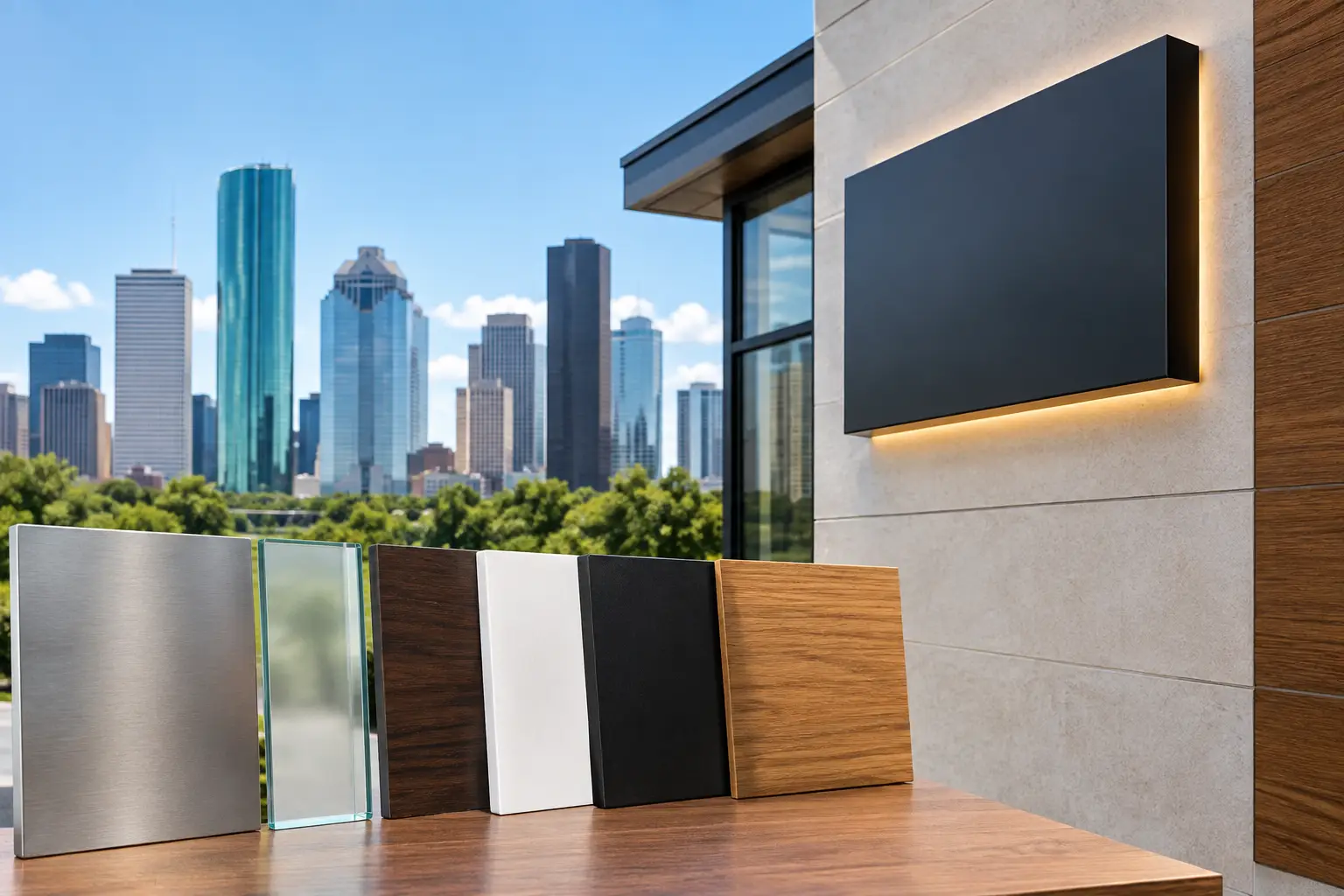
A sign can look great in a proof and still become a problem once it faces Houston sun, humidity, heavy rain, traffic exposure, and daily use. Choosing the right sign materials is what separates a polished business investment from a faded, warped, or unreliable sign that needs attention too soon. The right choice depends on where the sign will live, how far away it needs to be seen, how long it needs to perform, and what your brand needs to communicate.
For a storefront, office building, medical facility, restaurant, or commercial property, material selection should happen early in the design process. It affects the sign’s appearance, durability, illumination options, installation method, maintenance needs, and budget. A strong sign program does not start with the cheapest substrate. It starts with a material that fits the job.
Sign Materials Should Match the Location
There is no single best material for every business sign. An interior lobby logo has different demands than a monument sign near a busy roadway. Temporary window graphics need flexibility and speed, while a pylon sign must withstand years of weather and remain visible from a distance.
Houston conditions add another layer to the decision. High heat can affect adhesives, vinyl, paint finishes, and plastics. Humidity and rain make water management essential for illuminated cabinets and exterior electrical components. Strong sunlight can make low-quality colors fade faster than expected. Materials chosen for exterior signage should be specified for the actual exposure level, not simply selected because they worked for an indoor display.
A practical sign partner will also consider the property itself. Brick, stucco, metal panels, glass, concrete, and drywall each require different mounting methods and can influence which materials make sense. The material, fabrication method, and installation approach need to work together.
Aluminum: A Reliable Exterior Workhorse
Aluminum is one of the most widely used sign materials for good reason. It is lightweight, corrosion-resistant, and well suited for outdoor applications. It is commonly used for sign cabinets, post-and-panel signs, parking and directional signs, monument sign faces, dimensional letter returns, and wayfinding systems.
For businesses that need clean, professional exterior branding, aluminum offers a dependable foundation. It can be painted, finished, routed, printed, or paired with other materials. Aluminum composite material, often called ACM, is another common choice for flat sign panels and building-mounted signage. It provides a smooth, rigid surface with aluminum skins around a solid core, making it a practical option for many storefront and property identification signs.
The trade-off is that aluminum is often more about structure and longevity than visual depth by itself. A flat aluminum panel may be exactly right for a directional sign or tenant panel, but it may not create the premium dimensional look a law office, restaurant, or corporate lobby wants. In those cases, it can serve as the supporting structure behind acrylic letters, routed graphics, or illuminated elements.
When Aluminum Makes the Most Sense
Aluminum is a strong fit for signs exposed to regular weather, signs that need a rigid face, and projects where durability matters more than a decorative texture. It is also a smart choice for property managers who need a consistent system of parking, traffic, suite, and directional signage across a commercial site.
Acrylic Adds Depth and a Finished Look
Acrylic is popular when a sign needs dimension, color, and a polished surface. It is used for dimensional letters, logo elements, illuminated sign faces, lobby signs, menu boards, donor walls, and office branding. Acrylic can be clear, white, colored, frosted, or painted, and it delivers a crisp appearance that works especially well for professional interiors.
For exterior channel letters and cabinet signs, acrylic faces allow light to pass through while presenting the brand color during the day. For interior applications, thick acrylic letters mounted off the wall can create a refined shadow effect that makes a reception area feel more established.
However, acrylic is not automatically the best choice for every exterior sign. It can be more vulnerable to impact than metal and requires proper fabrication to avoid cracking, stress points, or discoloration over time. The thickness, mounting method, and lighting design all matter. A thin acrylic letter may be appropriate for a protected interior wall but not for a highly exposed building façade.
Vinyl Delivers Flexibility for Windows, Walls, and Vehicles
Vinyl is one of the most versatile materials in commercial signage. It is used for window graphics, wall graphics, vehicle lettering, full vehicle wraps, temporary promotions, safety decals, hours of operation, frosted privacy film, and interior graphics. It can be cut into lettering and shapes or printed with full-color images, patterns, and branded designs.
The advantage of vinyl is flexibility. A retailer can promote a seasonal offer on front windows, a service company can turn its work vehicles into mobile advertising, and an office can add branded privacy film to glass conference rooms without major construction. Vinyl is also useful when a message may need to change more often than a permanent sign.
Durability varies widely by product and application. Short-term promotional vinyl and high-performance cast vinyl are not interchangeable. A vehicle wrap needs a material designed to conform to curves, resist UV exposure, and hold up through routine washing. Window graphics need the right adhesive and opacity for the glass, viewing direction, and expected removal date. Selecting vinyl based only on color or initial price can lead to lifting edges, shrinking, fading, or difficult removal later.
PVC, Foam Board, and Corrugated Plastic Have a Place
Budget-friendly materials can be useful when the application is short term, temporary, or indoors. PVC board is a rigid plastic substrate often used for interior signs, temporary exterior panels, menu displays, and dimensional lettering. It is easy to fabricate and provides a clean painted finish, though it does not offer the same long-term exterior performance as aluminum.
Foam board is lightweight and economical for presentations, event displays, indoor promotions, and short-term point-of-sale signage. Corrugated plastic is commonly used for yard signs, construction notices, political signs, and temporary event directions. Both materials work best when expectations match the product. They are efficient tools for short-duration needs, not permanent replacements for professionally fabricated building signage.
For a business opening a new location, these materials can help bridge the gap while permanent signage is being designed, permitted, and fabricated. A temporary coming-soon panel, window graphic, or directional sign can keep the property visible and informative without overinvesting in a short-term solution.
Illuminated Signs Need the Right Materials Behind the Light
Illumination changes the material conversation. Channel letters, cabinet signs, monument signs, and pylon signs rely on faces, returns, trim, electrical components, and mounting systems that must work as a complete unit. An attractive sign face is not enough if the cabinet leaks, the lighting creates uneven brightness, or the material does not hold color under constant sun exposure.
Acrylic faces, aluminum returns, durable paint finishes, and quality LED components are common ingredients in illuminated signage. The exact combination depends on the sign type. Front-lit channel letters need a different approach than halo-lit letters, while a tenant cabinet sign has different requirements than an electronic message center.
LED lighting is efficient and widely used, but accessibility for future service should be part of the plan. Sign maintenance is easier and less disruptive when components can be reached safely and the cabinet or letter system was built for repair. This matters for restaurants, retail centers, medical offices, and other businesses that depend on visibility after dark.
Appearance Matters, but So Does Service Life
A material should support your brand’s intended look without creating unnecessary maintenance. Brushed metal may suit a professional office or upscale retail environment. Bold acrylic and LED illumination may be better for a restaurant competing for attention along a busy corridor. Durable printed vinyl may be the right answer for a fleet that spends every day in the field.
The key is to balance first impression with total value. A less expensive sign material may reduce the initial cost but require replacement sooner. A premium material may be unnecessary for an interior sign in a protected hallway. Good recommendations account for visibility, location, expected lifespan, cleaning requirements, property rules, and the possibility of future rebranding.
Plan Materials Alongside Permitting and Installation
For exterior commercial signage, material choices can affect permitting, engineering, and installation. Sign size, illumination, mounting height, wind load, electrical needs, and local property requirements may influence the final build. A monument sign, for example, is not just a sign face. It may involve a structural frame, masonry or aluminum cladding, footings, electrical access, and tenant changeable panels.
Planning these details before production prevents costly revisions. It also helps keep branding consistent across your main building sign, directional signs, window graphics, interior identification, and vehicles. A to Z Sign Company approaches material selection as part of the full project, from design and permitting through fabrication and installation.
The best sign material is the one that still represents your business well after opening day. Start with where the sign will be seen, what it must endure, and how long it needs to work. That gives your business a clearer path to signage that looks established, performs reliably, and keeps customers moving in the right direction.
Leave a Reply