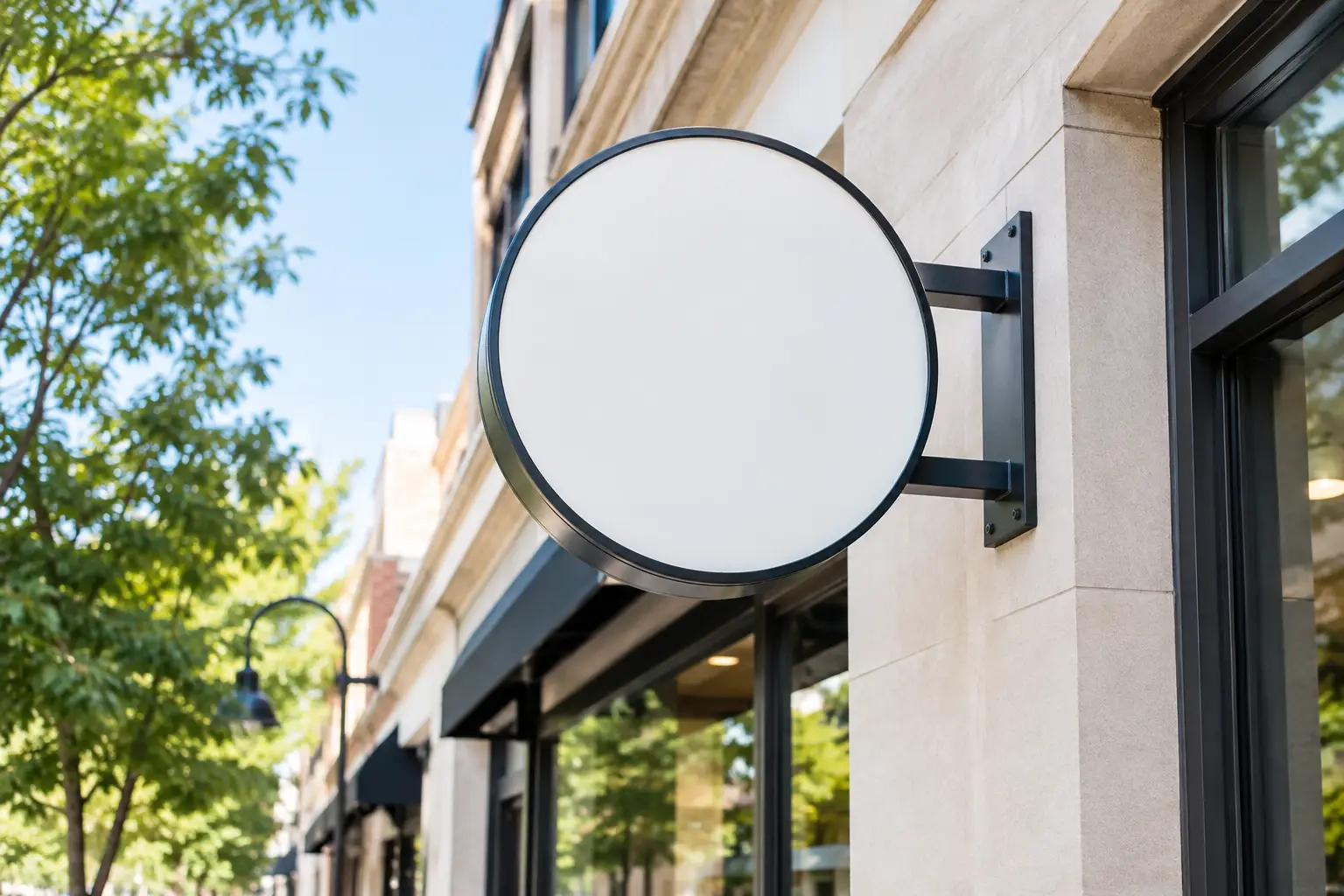
A customer may be standing directly in front of your business and still miss it. That is the problem blade signs are built to solve. Mounted perpendicular to a storefront or building facade, they project into the pedestrian line of sight, helping people spot your location from down the block, across a parking area, or while moving through a busy retail center.
For restaurants, boutiques, salons, medical offices, professional services, and multi-tenant properties, a blade sign can turn a hard-to-find entrance into a clear destination. It is not simply an extra logo. It is a visibility tool that works where flat wall signage has limited viewing angles.
What Is a Blade Sign?
A blade sign, also called a projecting sign, extends outward from a wall, canopy, or storefront. Unlike a sign installed flat against the building, it faces people approaching from either direction along a sidewalk or storefront row.
Most blade signs use a bracket, pole, or decorative mounting system anchored to the building structure. The sign panel can be rectangular, circular, shaped to match a logo, or built as a dimensional cabinet. Some are non-illuminated, while others use internal LEDs, halo lighting, or external gooseneck fixtures for evening visibility.
The best format depends on where customers first see your business. In a walkable area such as Downtown Houston, Rice Village, Houston Heights, or Midtown, pedestrians may see a projecting sign before they see your main storefront sign. In a shopping center, a blade sign can help drivers and visitors identify the correct suite once they have parked.
Why Blade Signs Work for Commercial Visibility
A storefront sign above the entrance is necessary, but it often disappears from side angles. People walking parallel to the building may not see it until they are already past your door. A blade sign creates a second viewing plane, putting your name, symbol, or message where foot traffic is naturally looking.
This added visibility is especially useful when your business is set back under a covered walkway, surrounded by neighboring tenants, or located in a building with architectural restrictions. It gives your brand presence without requiring a large street-facing sign.
Blade signs also make a location feel established. A well-designed sign with clean fabrication, proper mounting, and colors that match your overall identity sends a clear message before a customer enters: this business is professional, easy to find, and ready to serve.
They support wayfinding, not just branding
For offices, clinics, and service businesses, the value is often practical. Visitors may have an address but still need confirmation that they have reached the right door. A visible blade sign reduces hesitation and helps prevent missed appointments, late arrivals, and unnecessary calls for directions.
For restaurants and retail businesses, the sign does more. It helps create recognition for passersby who may not visit that day but will remember the name and location later.
Choosing the Right Blade Sign Design
The strongest blade signs are easy to read in seconds. They do not try to fit every detail of a business onto one panel. From a distance, a customer should be able to recognize the logo, name, or a simple category cue without stopping to decipher small text.
Start with the sign’s primary job. If your brand mark is already recognizable, a shaped logo sign may be enough. If your name is new or descriptive, clear lettering should take priority. A coffee shop, for example, may benefit from a logo plus a simple wordmark. A law office may need the firm name to be the most prominent element.
Color contrast matters as much as color selection. Light letters on a light background or dark letters on a dark background lose impact at a distance. Brand colors should be preserved, but they may need a contrasting border, background, or letter treatment to perform well outdoors.
Keep the message focused
A blade sign is not the place for a phone number, a long service list, or a full tagline. Those details belong on window graphics, wall signs, menus, directories, or other customer-facing materials. The projecting sign should identify the business quickly and reinforce the visual system used across the property.
This is particularly important for multi-location brands. Consistent sign proportions, logo placement, colors, and lighting help customers recognize the business whether they are visiting a Houston location, a suburban retail center, or an office suite in a mixed-use development.
Materials and Lighting for Houston Conditions
Houston signage needs to handle intense sun, high humidity, driving rain, and changing temperatures. Material choices affect both appearance and maintenance requirements over time.
Aluminum is a common choice for blade sign cabinets and panels because it is lightweight, durable, and resistant to corrosion. Acrylic faces can provide a polished illuminated look, while routed aluminum, dimensional lettering, and vinyl graphics allow for different levels of depth and detail. Steel brackets are often used when the sign needs substantial support, but they should be properly finished to resist weather exposure.
For a premium, architectural look, fabricated metal, wood-look finishes, and custom brackets can make sense. They also require a realistic discussion about budget, weight, maintenance, and building approval. The right solution is not always the most elaborate one. A clean aluminum cabinet with sharp graphics may deliver better long-term value for a high-traffic retail location.
When illumination makes sense
Illuminated blade signs are a smart investment when your business operates after dark, sits in a shaded corridor, or relies on evening traffic. Internal LED illumination offers strong, even visibility with low energy use. Halo-lit dimensional elements can create a more upscale effect, although they are usually better for signs viewed closer up.
Non-illuminated signs remain effective for daytime-focused offices, some interior-facing storefronts, and properties with good ambient lighting. If a sign is unlit, contrast, panel finish, and placement become even more important.
Placement, Mounting, and Code Considerations
A blade sign only works when it is positioned at the right height and projection. Too high, and it loses connection with pedestrian traffic. Too low, and it can create clearance problems. Too far from the facade may improve visibility, but it may also exceed lease rules, property standards, or local sign regulations.
Before fabrication begins, a professional sign company should evaluate the storefront, building materials, structural mounting points, utility access for lighting, nearby signs, and required clearance. The sign must look intentional and remain secure through normal weather conditions.
Permitting requirements can vary by municipality, property type, zoning district, and sign dimensions. A retail center may also have its own sign criteria covering size, colors, mounting methods, illumination, and approved locations. Planning for those requirements early helps avoid redesigns, delayed openings, or installation issues.
At A to Z Sign Company, the proof-to-install process is built around these real-world details. Design, fabrication, permitting, and installation need to work together so the final sign looks right on the building, not just on a screen.
Make Your Blade Sign Part of a Complete Sign Plan
A blade sign is most effective when it supports, rather than competes with, your other signage. Your primary storefront sign establishes presence from the front. Window graphics can communicate hours, services, or promotions. Interior signs guide customers once they enter. Vehicle graphics extend that recognition well beyond the property.
The goal is a consistent path: customers see your business, recognize your brand, locate the entrance, and know where to go next. If the logo, fonts, colors, and finish quality change from one sign to another, the experience feels less polished even when each individual piece is functional.
For a new location, consider the sign package before construction wraps up. Electrical needs, wall blocking, landlord approvals, and permit timelines are easier to address before the opening date becomes urgent. For an existing location, a blade sign is often a practical upgrade when your current storefront is difficult to spot or blends into the surrounding tenants.
A well-placed blade sign keeps working after the doors close each day. It gives people a landmark, gives customers confidence they are in the right place, and gives your business the visibility it needs to be remembered.
Leave a Reply